


Download the PDF of the 2025 Lutheran Youth and Adult Leader Poll Executive Summary
This summary was written by LCMS Research Services and LCMS Youth Ministry staff. Click here to see previous Youth Poll Executive Summaries.
About the Poll
The Lutheran Youth Poll (LYP) – formerly known as the Lutheran Youth Fellowship Poll – has been conducted every three years at LCMS Youth Gatherings since the 1980s. Over four decades, tens of thousands of LCMS teenagers have participated in the polls, providing insight into their beliefs, attitudes, and behaviors.
In July 2025, 1,267 youth took the poll at the Youth Gathering in New Orleans, LA. A related poll featuring several questions from the Youth Poll was also conducted among Adult Leaders (n=573) at the Gathering, as well as poll of Young Adult Volunteers (n=480). When relevant, some responses from those polls are mentioned in this report.
Who are the Youth at the Gathering?
The LYP seeks to understand the changing complexities of the lives of young people in the church, particularly related to their spiritual beliefs, attitudes, and behaviors. Additionally, the poll explores aspects of their upbringing and attempts to look ahead to where they think they are going in life. To summarize the results of the poll, this report explores six topics: Beliefs and Behaviors; Cultural “Hot Topics;” How Youth Spend Their Time; Social Media; Mental Health, and Changes in What Youth Find Important.
It is important to point out that the sample for the poll is uniquely biased. The sample of youth for this poll is not representative of all LCMS young people, but specifically of those who attended this Youth Gathering. The data shows that these particular youth are heavily involved in their home church and youth ministry. This bias toward heavily involved youth appears to be even stronger than in years before. In 2022, 70% of youth responding were weekly worship attenders, and in 2025 that jumped to 77%. While, on the surface, this may suggest a strengthening in commitment among Lutheran youth, it may also point to a “self-sorting” process, in which less committed youth are becoming less likely to attend an LCMS Youth Gathering.
| I am… | % | I am… | % | I attend… | % |
| Female | 62% | 14 years old | 21% | Worship weekly | 77% |
| Male | 38% | 15 years old | 24% | Worship less than weekly | 23% |
| 16 years old | 20% | ||||
| Confirmed LCMS | 90% | 17 years old | 18% | Public school | 64% |
| Baptized LCMS | 6% | 18 years old | 12% | Lutheran school | 18% |
| Other Christian | 3% | 19 years old | 2% | Other Private School | 10% |
| Not a Christian | 1% | Homeschool | 8% |
Youth Beliefs and Behaviors
Spiritual Beliefs
While the LYP is not a theology exam, it does ask a few key questions to gauge young people’s understanding of the basics of faith and how it relates to their daily life. What do these young people believe about salvation and the Bible, and how does that shape their daily habits and practices?
Key LYP Items Regarding Spiritual Beliefs and Disciplines
| Spiritual Belief or Practice | 2025 | 2022 | |
| Regarding Salvation: | |||
| To be saved you have to believe in Jesus Christ | 76% | 71% | |
| Many paths (faiths) lead to salvation | 7% | 12% | |
| Regarding the Bible: | |||
| Authority: The Bible is the true Word of God | 90% | 80% | |
| Relevance: The Bible is applicable today | 78% | 67% | |
| Truth: The Bible contains error mixed with truth (disagree) | 46% | 32% | |
| Spiritual Practices: | |||
| Pray on own daily | 62% | 53% | |
| Pray on own rarely or never | 11% | 17% | |
| Read the Bible on own multiple times a week | 36% | 26% | |
| Read the Bible on own rarely or never | 13% | 20% | |
| Rely on God to make life decisions (always or usually) | 66% | 59% | |
The good news is that these LCMS youth show high commitment to their faith, showing signs that their catechetical training has prepared them well. It may also indicate that those whose beliefs do not align with the teachings of the church are less likely to choose to attend a function like the LCMS Youth Gathering. Congregations may want to consider encouraging less engaged youth or even non-member guests of youth to attend the Gathering, where they would be exposed to the Gospel and solid Biblical teaching.
Risky Behaviors
The LYP also tracks certain risky behaviors. Just as these youth are more committed to their faith in their beliefs, youth in the 2025 Poll are less likely to have engaged in such behaviors. While some of the differences are slight, the fact that they are all down from 2022 makes the overall trend statistically significant.
Risky Behaviors Among Youth
| Youth Views on Specific Issues | 2025 | 2022 |
| Have never vaped or used e-cigarettes | 90% | 87% |
| Have never used any other tobacco products | 94% | 94% |
| Have never used Marijuana | 94% | 91% |
| Have never drunk alcohol (other than the Lord’s Supper) | 75% | 63% |
| Have never drunk more than five alcoholic drinks in 24 hours | 93% | 91% |
| Have never viewed pornography | 71% | 68% |
| Have never been sexually active | 82% | 73% |
It should be noted that most of the increase in “have never used” came from the decreasing number of youth who “had tried”. Responses of “occasionally” and “regularly” (while very small for most of these behaviors) have hardly changed since the 2019 Poll. While the rare cases of habitual use have not changed, the youth in 2025 were less likely to have experimented with these vices. This tracks with national data that reports overall lower rates of teen smoking, drug use, and sexual activity.
Youth Perspectives on Cultural “Hot Topics”
In addition to asking questions related to their faith and spiritual beliefs, the LYP asks youth a series of questions on topics that are polarizing in today’s culture. These items further show how this year’s youth display a stronger commitment to doctrinal teaching than the youth in 2022.
LYP Items on Youth Views of Hot Topics
| Youth Views on Specific Issues | 2025 | 2022 |
| Sexuality and Gender: | ||
| Pre-marital sex is always wrong | 64% | 45% |
| Homosexual acts are always wrong | 62% | 47% |
| Changing one’s biological sex from birth is wrong* | 76% | NA |
| Abortion: | ||
| Abortion should always be illegal | 35% | 33% |
| A woman should have the right to choose | 19% | 26% |
| Religion and Science: | ||
| Women cannot be pastors | 35% | 26% |
| Humans were uniquely created by God at one time and pretty much in our current form | 72% | 65% |
| * Combined responses for “always wrong” or “wrong except in rare medical circumstances.” | ||
Additionally, in several items related to hot topics, the 2025 poll responses showed a slowing of a trend of increasing “I don’t know” responses. This was a marked contrast from recent polls where the number of teens who had not yet made up their mind was steadily increasing. This flattening of “I don’t know” was most notable for the issues of pre-marital sex and homosexuality, where “I don’t know” responses dropped by over 5 percentage-points from 2022.
While this suggests more teens are thinking through these issues, it is good to know that more of them are having their beliefs shaped to be in line with confessional teaching. On the one hand, this suggests that catechesis and Bible Study are forming youth into strong disciples, but it also may reflect a growing trend in society at large of people dividing themselves into isolated groups that share similar beliefs.
Busy Lives of Teenagers
The LYP does not only focus on controversial topics, but it also tries to understand the day-to-day lives of today’s teens. Another key aspect of the lives of today’s young people is how and where they spend their time and how little free time they actually have.
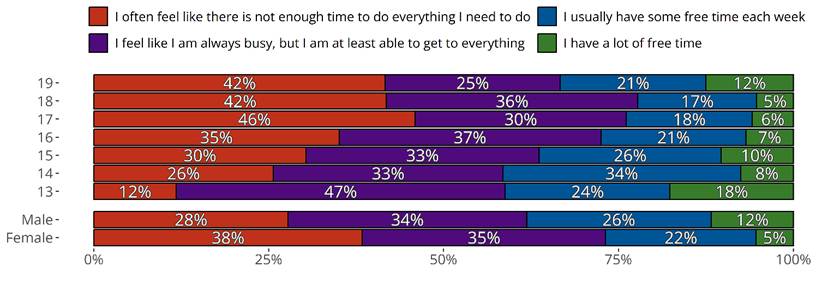
Most youth (with no difference by age, gender, or church involvement) say they are too busy. Over two-thirds of youth feel they are “always busy” with 35% saying they don’t have enough time to get everything done. Numbers from previous polls have been similar.
Busyness Increases with Age
While teens of all ages are busy, there is a definite trend in increasing busyness as teens get older, peaking at age 17 (for most youth at the Gathering, this would be the summer before their senior year of high school). The Poll also found that females tend to feel busier than males, with boys being more likely to have large amounts of free time.
How Youth Spend Their Time
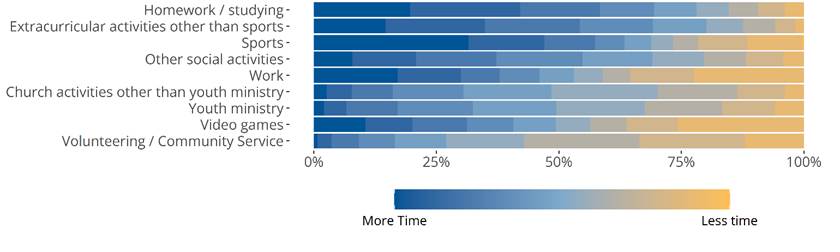
Most youth spend the bulk of their time studying or doing non-sport extracurricular activities. While many do not do any sports or work, the busiest youth prioritize time for one or both. Meanwhile, the youth with the most free time are the most likely to fill their time with video games. Many youth leaders express frustration over the priorities teens use to manage time. Because we ask about time usage over the course of a single week, the lower amount of reported time spent on church and youth activities is not necessarily indicative of low priority for faith activities. The youth most committed to church rank church activities and youth ministry low in their schedules, but, importantly, these are not absent. It is important for parents and youth leaders to work alongside teens to help them manage time and set Godly priorities for what they choose to do.
Social Media
Recently, the LYP has begun tracking the rapidly changing world of social media. In prior years, the Poll attempted to track what platforms were being used. This year, the Poll focused attention on how and why youth use it, as well as gauging how they feel about their use of social media.
What Today’s Youth Use Social Media For
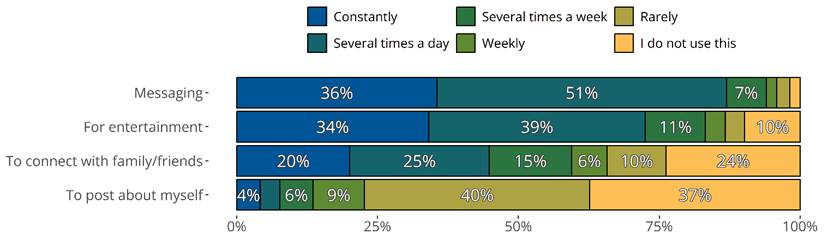
Most of these youth are not on social media to post publicly. Rather, they use it to communicate with friends or to be entertained. This means youth leaders and parents may glean less information from a youth’s profile than in years past. While these youth will rarely or never post about themselves, they are online taking in what others post. This may foster a new discussion about how to connect with youth in and out of congregational youth ministry including policies for using DM with minors.
How Do Youth Feel About Their Social Media Usage
And yet, most youth recognize they spend too much time on social media. Very few feel that they should spend more time on social media, and nearly three-quarters think their usage should decrease.
How Youth View Time Spent on Social Media How Has that Time Changed in the Past Year
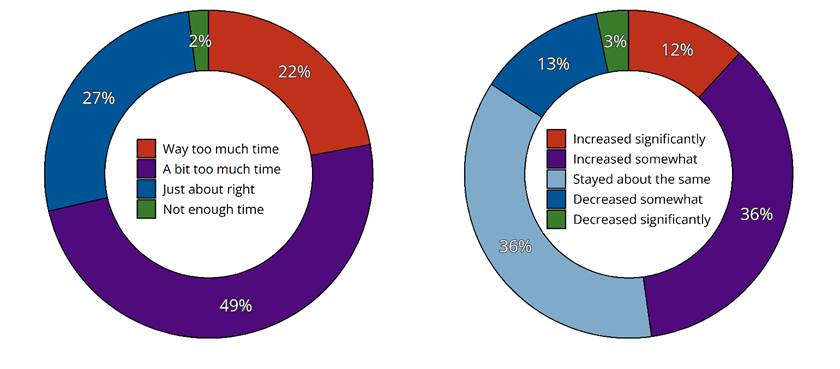
Youth who say their usage has increased significantly in the last year, were over twice as likely as others to say they spend “way too much time” on social media. This suggests that while these young people recognize they spend too much time online, they find the draw of social media difficult to resist. It may be important to explicitly talk with you about social media usage and how it can impact their social, emotional and spiritual lives. It is also valuable for parents and supportive adults to both model healthy relationships to technology and talk about how they manage this part of their lives.
Who Places Restrictions, If Any, on Their Social Media Use
The 2025 LYP also added questions to explore where restrictions on social media usage are coming from. Are parents setting rules? What about churches and youth group? How much do school and work set restrictions? Are youth regulating themselves?
Who Has Imposed Rules on Social Media and Messaging Use
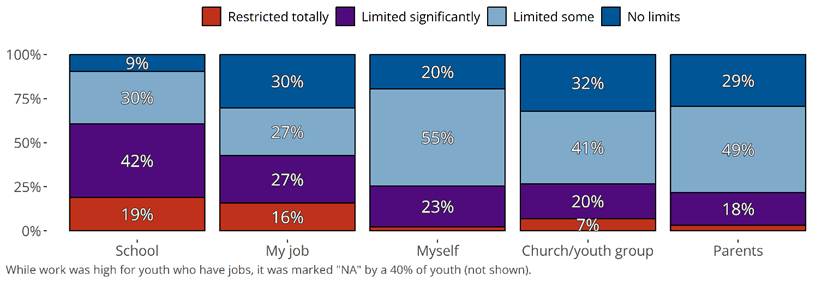
Work (for youth who have jobs) and school are the most likely sources of restrictions on social media usage. The high volume of students marking “restricted totally” for school and work, may need to be interpreted as a total restriction only while present at school or work, whereas responses about “parents” or “myself” may indicate more of a comprehensive restriction.
It is positive to see signs that youth are regulating their own usage – or at least attempting too. On the other hand, it may be surprising to some that there are many parents who do not limit their teen use of social media, or only limit it a little.
Mental Health
There has been a steady rise in awareness and concerns over mental health in recent years, with growing numbers of youth struggling with issues including anxiety, depression and eating disorders. The LYP found that over a third (34%) of youth say they have struggled with their mental health in the past year, with another 23% saying they had struggles in the past but not in the last year.
Likewise, 42% of youth say a close family member or friend has had mental health struggles in the last year. Among all youth, 77% say either they or someone close to them has had mental health struggles.
Where Youth Say They Would Turn If Struggling
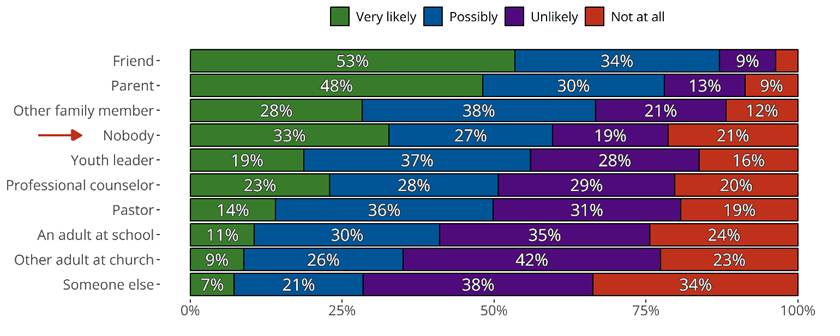
Youth are most likely to talk about their struggles with their friends, but it is important to notice that parents are a close second. Youth leaders, pastors, and counselors are noticeably low on the list, with a majority of youth saying they would be unlikely to talk to them. Perhaps most disheartening is that talking to “Nobody” is among the most likely outcomes. Data from Springtide Research seems to emphasize the concern around youth telling no one of their struggles. They found that 61% of young people agreed “The adults in my life don’t truly know how much I am struggling with my mental health.”[1]
Gender Divide in Mental Health and Other Issues
There are several items in the poll with notable differences between male and female youth, but one of the widest gaps was in the responses about mental health. Teen girls are more than twice as likely as boys to have had mental health struggles in the last year (42% vs 20%). Likewise, boys are twice as likely to not know if someone close to them has had a mental health struggle (24% of boys “don’t know” versus only 13% of girls).
While girls are much more likely to struggle with mental health, they are even less likely than boys to talk about it with their pastor. This may be related to an earlier Poll question, that showed girls are less likely to agree that their pastor cares about them as a person. Additionally, this pattern is not just for youth. The same trend was observed in results from young adult women who took the poll.
Across the poll, there were other clear distinctions along the lines of gender. The following table shows several major places in the poll with divides across gender lines.
Items Across the Poll with a Notable Gender Divide
| Item | Female | Male |
| Believe homosexual acts are always wrong | 56% | 74% |
| Believe pre-marital sex is always wrong | 61% | 70% |
| Have never had sex | 81% | 84% |
| Have never viewed pornography | 82% | 53% |
| Personal struggle with mental health | 41% | 20% |
| Loved one struggle with mental health | 48% | 32% |
| My pastor cares about me as a person | 60% | 69% |
| NOT likely to talk to Pastor | 22% | 14% |
It is important to note that there may be a variety of reasons behind the divides in these answers. While certainly something to pay attention to, we do not know exactly why the difference appears in the data.
Changes in Important Issues Among Youth
The poll concludes by asking youth to rank issues according to how important they seem. It first asks for their top three major concerns in life, then it asks for them to list three topics they wish their church would talk about more.
Overall, the top concerns for youth did not change significantly from the previous Poll. Abortion, mental health, and planning for the future remain the areas most youth are concerned with overall. Other common concerns include getting good grades, physical/sexual abuse, war, and social media/phone addiction (which was introduced to the list this year.)
While the question about their concerns gave them a list to check from, the question of topics for the church to address was open-ended. Many of these items remained consistent with previous polls. Mental health, relationships and apologetics/outreach remained very high, but notably, there was a newly elevated topic.
Showing Loving Rather Than Divisiveness
On all three versions of the poll (youth, adult and young adult volunteer), significant numbers of poll respondents said they want the church to talk more about loving neighbors rather than joining in a highly polarized culture. A common word used by many was “divisive” – as they are concerned with how divided the culture is. The new prominence of this item is especially significant since it was not prompted, but each person provided it in their own words. It is also significant that it was prominent across youth, adult, and young adult respondents.
It may be important to keep in mind that presence on this list does not mean churches are not talking about an issue. Most literally it means it is an important issue that youth want the church to emphasize.
Conclusion
The 2025 LYP shows that the Lutheran youth present at the LCMS Youth Gathering were more committed and stronger in their faith than previous years of Gathering participants. They demonstrated a higher level of positive spiritual practices, lower rates of risky behaviors, and stronger affirmation of Biblical teachings on issues that are polarizing to today’s culture. Furthermore, these busy youth are feeling pulled to prioritize their time in many places, while their mental health challenges are mounting. Finally, these young people see how sharply divided our culture is and want the church to champion the message of loving our neighbors.
Yet, as youth grow stronger in their affirmation of Biblical teachings, they want their church to emphasize the love of neighbor. Just as the church’s Biblical positions on sexuality and gender have become counter-cultural, teaching people to love their neighbor almost feels like a revolution in today’s sharply divided culture. The church has done well in catechizing these young people to believe the Bible rather than the culture in many areas. Now, these young people want their Church to believe the Bible rather than the culture when it comes to how we act around those who believe differently.
Download the PDF of the 2025 Lutheran Youth and Adult Leader Poll Executive Summary
[1] https://springtideresearch.org/resources/mental-health-gen-z?srsltid=AfmBOoqy9gDRBDgsltNgJMnvTFsEe4dE9i-sCoURGNuCbUB8vvbQaORF



0 Comments